
July 28, 2026
AI is transforming healthcare, but it's still hard: takeaways from six months in healthtech VC


Mar 11, 2026

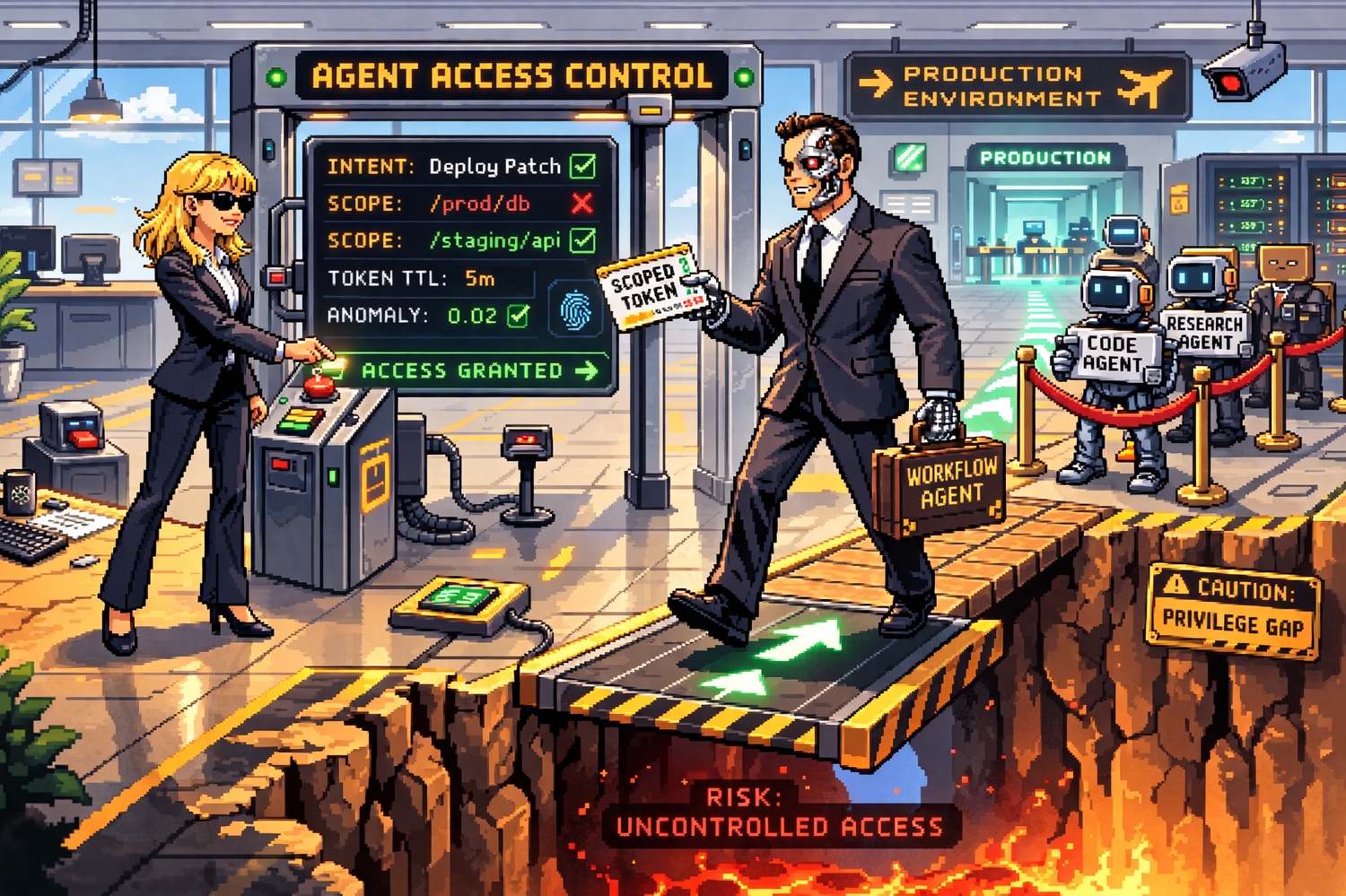
AI agents are no longer copilots in a chat box. They now execute code, access production databases, make authenticated API calls, orchestrate workflows across software and internal tools, and invoke new capabilities dynamically through MCPs. This capability shift, from answers to actions, is why we believe agent security will be a defining infrastructure category necessary to unlock fully autonomous enterprise agents.
AI/ML is not a new concept in security. Enterprises have run AI/ML based fraud detection, anomaly detection, and behavioral analytics models in production for over a decade. However, LLMs changed the underlying value-prop of what AI meant in enterprises. Instead of AI being embedded into products for analytics, AI was the product that could reason across unstructured information and generalize across tasks.
When productionizing LLMs meant a chatbot, security was largely around content filtering; keeping bad inputs out, and keeping sensitive outputs in. The 2024/25 AI Security M&A wave saw large security incumbents quickly acquire the first generation of LLM security tools built around guardrails, prompt scanning, and input/output filtering:
However, these acquisitions were more about strategic positioning than validated enterprise adoption (most acquired companies had well below $10M in ARR). And just 1 year later, the landscape is already different. The shift from LLMs as chatbots to LLMs powering agents changed everything.
Agents have moved beyond chat into execution, and enterprises now have growing fleets of “Shadow AI” embedded across teams. In nearly every enterprise, the same tension exists: leaders want to safely move sanctioned agents from read-only to write access, but they’re equally concerned about the unsanctioned agents already operating outside their visibility.
In our conversations with large enterprises, a consistent pattern emerged: everyone has active agent pilots, but almost all are stuck in read-only mode. Agents can retrieve and summarize information, but organizations are nervous to grant write access to production systems. The read-to-write transition should generate an order-of-magnitude difference in value, but the controls to enable autonomous agents are still immature.
Paradoxically, that caution only applies to sanctioned 3rd party agents from vendors. Internal agent sprawl has become the new shadow IT. Developers and non-developers can build agents with access to production data in an afternoon with no security review, identity assignment, or recorded intent. The result is the worst of both worlds: sanctioned agents are bottlenecked, while unsanctioned agents are sprawling with no controls at all.
Traditional security often assumes misbehavior and enforces deterministic controls across humans and non-human identities. AI safety focuses on improving behavior through training, guardrails, and evaluation. AI agents require both because what is “secure” and “correct” is highly context dependent.
When agents become executional, they reason probabilistically, merge data with instructions, chain tools across systems, and act autonomously inside trusted environments. Behavioral guardrails alone won’t contain them, and legacy controls lack visibility into task-level intent. Securing agents will require a combination of improving agent reasoning and constraining agent authority through a deterministic control plane purpose built for autonomous agents.
We're excited to back teams building the next wave of AI Security: the infrastructure that gives organizations confidence to grant agents autonomous write access to production systems.
This includes:
We're looking for teams who understand that agent security is not an extension of LLM security. Many underlying security primitives (sandboxing, isolation, permissioning, auditing) have existed for decades; but the pacing, non-determinism, and autonomy of agents change the equation enough that porting over existing solutions won't work.
We're at the beginning of securing the agentic era, and we believe it's a massive opportunity that will need new security solutions. If you're building in this space, we'd love to hear from you. Reach out at rohan@cowboy.vc.
Lorem ipsum dolor sit amet, consectetur adipiscing elit, sed do eiusmod tempor incididunt ut labore et dolore magna aliqua. Ut enim ad minim veniam, quis nostrud exercitation ullamco laboris nisi ut aliquip ex ea commodo consequat. Duis aute irure dolor in reprehenderit in voluptate velit esse cillum dolore eu fugiat nulla pariatur.
Block quote
Ordered list
Unordered list
Bold text
Emphasis
Superscript
Subscrinolkm;pvdidunt ut labore et dolore magna aliqua. Ut enim ad minim veniam, quis nostrud exercitation ullamco laboris nisi ut aliquip ex ea commodo consequat. Duis aute irure dolor in represdasc

